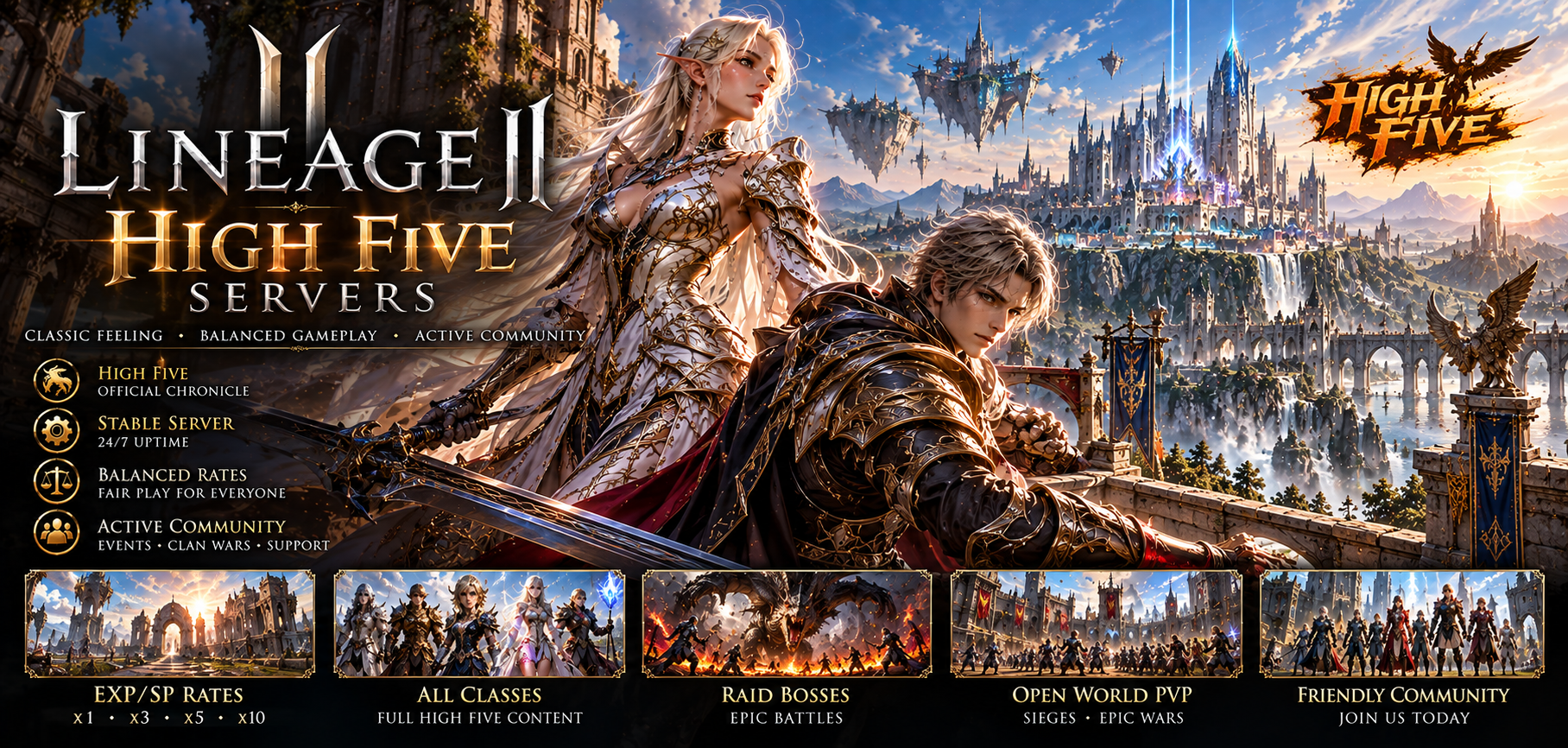
There is something unusually balanced about lineage 2 high five servers. High Five sits between the older, slower style of Lineage 2 and the more streamlined versions that came later, giving players a familiar progression system without making every part of the game feel like a long grind.
A version built around variety
High Five is remembered by many players for the amount of content available without making the game feel completely disconnected from its earlier design. Characters still need time to develop, equipment matters, and party play can make a noticeable difference.
What changes is the range of things a developed character can actually do.
You might spend one evening working on equipment and another helping a clan prepare for a larger activity. There are reasons to return to familiar hunting areas, but there are also enough additional goals to prevent the world from feeling static.
That variety changes the rhythm of progression. Reaching a higher level does not necessarily mean that the previous stage of the game has become completely irrelevant. Certain locations, items, and activities can continue to have a purpose.
For players who dislike extremely slow progression but still want their character to feel earned, that balance can be appealing.
It is also why l2 high five servers can attract people with very different expectations. One player may be interested mainly in PvE and character development. Another may be looking for clan competition. A third might care almost entirely about PvP.
The same game can accommodate all three, provided the server community supports it.
PvP feels different when there is something at stake
High Five is particularly interesting for players who enjoy competition between groups rather than isolated duels.
A good l2 high five pvp server is not simply a place where players fight whenever they meet. The more interesting conflicts usually happen because there is something worth controlling: a location, a raid boss, resources, territory, or a position of influence within the server economy.
That gives PvP context.
Imagine arriving at a hunting area and discovering another clan already there. The situation can be handled peacefully, but it can also turn into a fight. If the location is valuable enough, neither side may want to leave. Suddenly a routine farming session becomes a small part of a much larger rivalry.
These encounters are what make persistent multiplayer games memorable. They are not completely scripted, so nobody knows exactly how the evening will develop.
Of course, a PvP-focused environment can become exhausting if every interaction turns into a conflict. Some players enjoy constant pressure; others need quieter periods where they can simply develop their characters.
The balance between competition and breathing room therefore matters more than the presence of PvP itself.
Why the community can change everything
Two servers running the same version of Lineage 2 can feel like completely different games.
One might have several large clans competing for control, while another is dominated by a small number of established players. In one community, ordinary players regularly form parties with people they have never met. In another, most activities happen inside closed groups.
This becomes noticeable quite quickly.
A crowded town is not necessarily proof of a healthy community. What matters is what those players are doing once they leave town. Are hunting locations active? Is there a functioning market? Do smaller clans have opportunities to grow? Are there rival groups capable of challenging the strongest players?
The answers create the real character of a server.
High Five benefits particularly from this kind of interaction because its content gives players several reasons to cooperate and compete. A clan can have goals that extend well beyond simply reaching the maximum level. Equipment, territory, raids, relationships with other groups and reputation all become part of the larger picture.
That social layer is difficult to replace with faster progression.
The appeal of a familiar middle ground
For someone returning to Lineage 2, High Five can feel like a comfortable compromise. It retains many of the ideas that made the older game memorable while offering a broader range of activities than the earliest versions.
There is also less pressure to treat every session as a race.
You can spend an evening improving a character, join a group for a specific activity, help a clan member, or simply explore content you have not touched for years. The game gives you several directions to move in rather than forcing every player toward exactly the same objective.
That flexibility may explain why lineage 2 high five servers continue to interest players who have already experienced other chronicles. High Five does not depend entirely on nostalgia. Its appeal comes from the way progression, group play, PvP and the wider game world fit together.
For some players, the ideal experience is not the fastest possible route to maximum level. It is having enough progression to make upgrades meaningful, enough competition to keep the world unpredictable, and enough variety to avoid doing exactly the same thing every evening.
High Five sits comfortably in that space. A good l2 high five pvp server can turn familiar mechanics into something surprisingly dynamic when the community is active and the competition has real consequences. And once that happens, the version number becomes much less important than the stories that players create around it.
About the Author