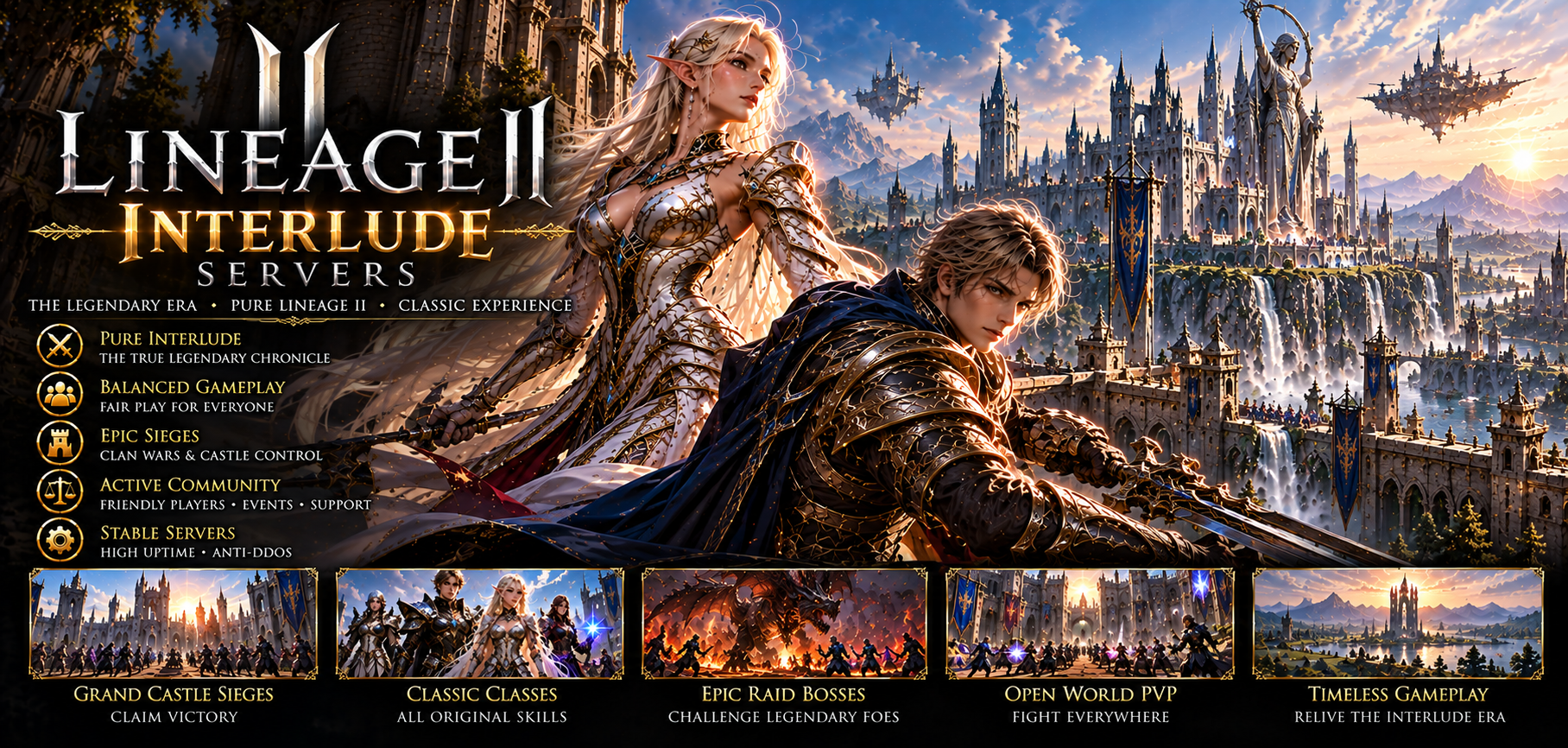
There is a particular rhythm to l2 interlude servers that many returning players recognize almost immediately. The world feels slower than newer versions of the game, but that slower pace often makes individual achievements, encounters, and decisions feel more meaningful.
The appeal of a simpler progression
Interlude occupies an interesting place in the history of Lineage 2. It has enough depth to keep experienced players busy, yet its basic systems are relatively easy to understand once you get back into the game. You know what your character needs, where to hunt, which equipment matters, and why certain locations are worth visiting.
That familiarity is part of the attraction.
A new character does not become powerful overnight. Even when progression is accelerated, there is usually a sense that equipment and levels have to be earned rather than simply collected. A weapon upgrade can change the way a hunting spot feels. A new skill can make a difficult encounter manageable. Small improvements accumulate until, at some point, you realize that the character you started with barely resembles the one you are playing now.
Modern games often try to remove friction from progression. Interlude does almost the opposite. Some things take time, and that time becomes part of the experience.
Of course, not everyone enjoys it. A player accustomed to extremely fast progression may find the early stages repetitive. Someone who has limited time can also become frustrated when a particular item or level requires several evenings of work. The same feature that creates satisfaction for one player can feel like unnecessary effort to another.
Where the old-school atmosphere comes from
The difference is not only mechanical. It is also social.
In older Lineage 2 gameplay, other players were often unavoidable. You needed them for parties, clan activities, raids and larger PvP encounters. Even when you preferred to play alone, the presence of other people shaped the world around you.
That becomes especially noticeable on active lineage 2 interlude servers. A hunting area can become a meeting point. Players recognize regular opponents. A clan starts controlling a particular zone. Someone is selling materials in town every evening. None of these things is a separate feature, yet together they create the feeling that the server has its own history.
There is also a certain unpredictability to this kind of environment. You may arrive at a familiar location expecting an ordinary farming session and discover another group already there. Perhaps you negotiate. Perhaps you leave. Perhaps the situation turns into PvP.
The game does not need to tell you that something important is happening. The players create the situation themselves.
This is one reason an active community can matter more than an impressive list of server settings. If there are people around who have their own goals, rivalries and routines, even familiar content can remain interesting.
Not every Interlude server plays the same way
It is tempting to assume that all l2 interlude projects offer roughly the same experience because they are based on the same version of the game. In practice, the differences can be quite noticeable.
Rates are an obvious example. A high-rate environment changes the importance of early equipment and reduces the amount of time spent leveling. A low-rate server makes ordinary drops, crafting materials and incremental upgrades much more significant.
Then there is the question of PvP.
Some communities are built around constant competition. Players fight over farming locations, raid bosses and territory, and a character’s strength is measured partly by how well it performs against other players. Elsewhere, PvE and clan cooperation may dominate, with PvP appearing mainly during scheduled events or major conflicts.
Neither style is inherently better. The problem only starts when the server’s atmosphere does not match what the player expected.
Even the economy can change the experience dramatically. If valuable materials circulate between players, farming has a clear purpose beyond gaining experience. If the market becomes stagnant, activities that once felt worthwhile can lose their meaning.
This is why simply reading a server description is rarely enough to understand how it actually plays. The same Interlude mechanics can produce very different worlds depending on the people using them.
Why players keep coming back
There is a reason Interlude continues to attract people who already know the game extremely well. Part of it is nostalgia, certainly, but nostalgia alone does not explain everything.
A player returning after many years may remember spending an entire evening trying to obtain one item. At the time, that probably felt normal. Today, with less free time, the same process might seem excessive. Yet when the reward finally arrives, the satisfaction can be surprisingly strong.
That contradiction is central to the Interlude experience. The game can be inconvenient, but those inconveniences sometimes give progress weight.
A character is not simply a collection of statistics. It represents the evenings spent leveling, the people met along the way, the failed raids, unexpected victories, expensive purchases and occasional mistakes. Two characters with similar equipment can have completely different stories behind them.
And that is where l2 interlude servers can become more than a place to repeat old content. A good server gives players enough continuity for those stories to develop naturally. You remember names. You recognize clans. You know which areas are dangerous and which players are likely to start a fight.
Eventually, the numbers become less important. You log in because something is happening, or because there is unfinished business from the previous evening.
That is probably the strongest argument for the enduring appeal of Interlude. l2 interlude servers may use an old game version, but the experience does not have to feel old when the community around it is active and unpredictable. Sometimes a familiar world remains interesting simply because there are still people in it who can surprise you.
About the Author