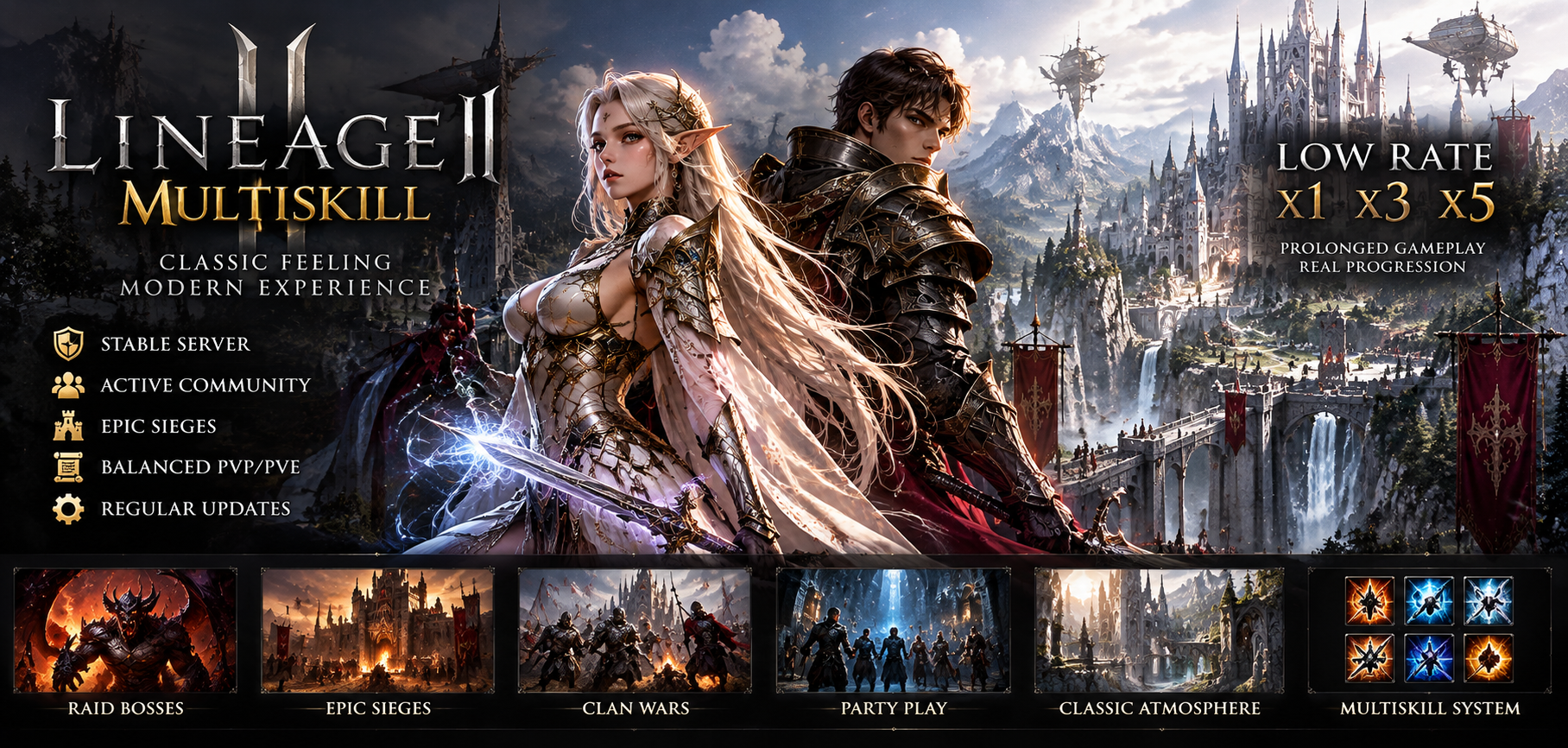
The idea behind l2 multiskill servers is simple but changes the familiar game in a fundamental way. Instead of being limited to the abilities associated with one class, a character can combine skills from different paths and create a build that would normally be impossible.
When one character can do more
Traditional Lineage 2 classes have clear identities. A fighter has one set of strengths, a healer another, and a support character fills a completely different role. That separation is part of what makes party composition important.
Multiskill changes that relationship.
A character can borrow abilities that normally belong to another class, creating combinations that are difficult to predict at first. A player might build around damage while adding defensive tools, or take useful support abilities without giving up the offensive capabilities of the main class.
The result is a game where choosing a character is only the beginning.
Two players can start with a similar foundation and eventually end up with completely different builds. One may focus on surviving longer in PvP, while another sacrifices defense for burst damage. Someone else might create a hybrid designed to handle several situations reasonably well rather than dominate one particular role.
That freedom is probably the biggest attraction of l2 multiskill servers.
It also creates a new problem: there are usually combinations that work much better than others. Once players begin experimenting, they naturally search for the most effective skill combinations. The game becomes partly about discovering those combinations before everyone else does.
The meta becomes part of the game
In a conventional server, players generally understand what to expect from a class. If you see a familiar character approaching, you already have some idea of its strengths and weaknesses.
With multiskill mechanics, that certainty disappears.
A character may look familiar but behave completely differently. An opponent who appears to be focused on offense could have defensive or control abilities that make the usual response ineffective. This makes PvP more difficult to read, particularly when players are still discovering which combinations work best.
That uncertainty can be fun.
It rewards observation rather than simply memorizing class matchups. After enough battles, players begin recognizing certain builds and adjusting their own characters accordingly. A new combination appears, becomes popular, gets countered, and eventually something else takes its place.
This is where the competitive side becomes particularly interesting. The strongest build on the first week may not remain dominant forever.
Players experiment. Someone discovers an unusual combination. Others copy it. A counter appears. The cycle continues.
In other words, the server develops its own meta rather than simply inheriting one from the original class system.
More freedom also means more responsibility
There is an obvious downside to having so many possibilities: making a bad choice can be expensive.
A player who has never dealt with multiskill mechanics may choose abilities because they look powerful individually. Later, it becomes clear that the skills do not work well together.
This is one of those situations where understanding the relationship between abilities matters more than the abilities themselves.
A defensive skill might sound useful, but if the build already has another way to survive, investing resources into it could be inefficient. A powerful attack may look impressive on paper while requiring conditions that the rest of the build cannot provide.
That is why experimentation becomes such an important part of lineage 2 multiskill server gameplay.
Not every experiment has to succeed. In fact, some of the most useful discoveries come from combinations that initially seem strange. A player tries something because it looks interesting, loses a few fights, changes one part of the build, and eventually finds a combination that works.
The process feels more personal than simply following a standard class guide.
Different characters can fill unexpected roles
Multiskill systems also change group play.
A character that would normally have one obvious role may be able to cover several functions. That does not necessarily eliminate the need for specialized players, but it can make party composition more flexible.
A group might adapt its setup depending on the situation. One player changes skills for PvP, another prepares for PvE, and a third focuses on support abilities for a particular encounter.
This flexibility can be especially useful when players have limited time. Instead of maintaining several characters for different purposes, one character can potentially adapt to different activities.
There is a cost, though. Greater flexibility can make characters harder to understand, especially for newcomers. The number of possible combinations grows quickly, and what works in one situation may be ineffective in another.
That complexity is part of the appeal for experienced players. There is always another build to test, another combination to improve, or another opponent whose setup needs to be figured out.
The important thing is that multiskill does not simply make characters stronger. It changes how players think about character development.
With l2 multiskill, the question is no longer only which class you want to play. It becomes which combination of abilities best represents the way you want to play it.
That shift can make familiar Lineage 2 mechanics feel almost new again. A character is no longer locked into one predictable role, and the strongest setup is rarely obvious forever. The most interesting part may be the period before everyone has figured it out — when players are still experimenting, surprising each other, and discovering what the system can actually do.